NoaPlateFood & Drink Diary Download the app

We eat a lot more than we think

Most of us don't know how much we really eat, let alone how many calories, how much protein, sugar and sodium are on our plate. NoaPlate is a food and drink diary: photograph your plate, type or say what you ate, and the diary works out the values and compares them with your own daily recommendation.

Keep it on your home screenA must, so the diary opens as an app. How do you do it?

Right now: a 30-day free trial, no credit card.

A plate: the orange circle is what we actually ate, and the dashed circle inside it is what we reported eating, only about half 47% What we think we ate
What we actually ateWhat we think we ate In a study published in the New England Journal of Medicine, participants reported eating 47% less food than they actually ate.1

Why it matters

Study after study shows that people underestimate what they eat: the amount, and above all the calories and the nutritional values. This gap is not about honesty. It is simply hard to remember every bite, and hard to guess what is in a meal.

Logging itself changes habits

When every meal is written down, you see it. A "small" snack logged three times a day becomes a number, and a number is hard to ignore. Keeping a diary cuts down on grazing and junk food, and builds awareness of the kinds of food you eat and what is in them: how much protein you had today, how much sugar, how much sodium.

And most important: it only works if it is easy. That is why in the diary you write a whole meal in one line, and the values are worked out for you.

Facts about eating

What the studies show

47% less
is what study participants reported eating, compared with what was actually measured. They also reported 51% more physical activity.Lichtman et al., NEJM, 1992
175 calories
On average, adults underestimated the calories in a fast-food meal they had just bought. About a quarter of them were off by 500 calories or more.Block et al., BMJ, 2013
2×
the weight loss for participants who kept a daily food diary, compared with those who did not, in a study of about 1,700 people.Hollis et al., American Journal of Preventive Medicine, 2008
3 minutes
a day is all it takes to know what goes into your body: with NoaPlate, adding a meal takes less than a minute. In a study, the most successful participants logged three times a day or more, day after day, and what made the difference was the logging itself, not the time spent on it.Harvey et al., Obesity, 2019
A consistent link
between self-monitoring of eating and weight loss, found in a systematic review of the studies.Burke et al., Journal of the American Dietetic Association, 2011

And what about water?

Our body is mostly water, and water takes part in almost everything it does: keeping our temperature, carrying nutrients, clearing waste through the kidneys, concentration and mood, and even how fresh and supple our skin is. And yet studies in dozens of countries show that many of us drink less than the body needs, without noticing.

How much should you drink?

According to the European recommendation (EFSA), a woman needs about 2 litres of water a day and a man about 2.5 litres, from all sources together. About 80% of it comes from drinks:6

Woman: 8 glasses
Man: 10 glasses
A glass is about 200 ml. In hot weather, with exercise, in pregnancy and while breastfeeding, you need more.

Kidneys

The kidneys filter the blood all the time, and they need water to clear waste. Drinking enough is one of the simplest ways to prevent kidney stones.

Focus and energy

Even mild dehydration, before you feel thirsty, impairs concentration and mood, and can bring on tiredness and headaches.

Healthy ageing

A 30-year study found that people who drink little tend to age faster biologically and to have more chronic diseases. It is a link, not proof, but the direction is consistent.

Fresh skin

The skin is the largest organ of the body, and it needs water too. When people drink more, skin hydration improves, above all in those who drank little before. Hydrated skin is softer and more supple.

The problem is not knowing, it is remembering. That is why in the diary every glass is logged with one tap, and your phone reminds you to drink when you need to.

Facts about drinking

What the studies show

1 in 3
adults in the US were found, by a urine test, not to drink enough, in a survey of about 9,500 people. They also had a higher body mass index (BMI).Chang et al., Annals of Family Medicine, 2016
60%
of men and about 40% of women drank less than recommended, in a survey of more than 16,000 adults in 13 countries.Ferreira-Pêgo et al., European Journal of Nutrition, 2015
1.4%
of body weight, only mild dehydration, was enough to lower mood and concentration and to cause headaches in healthy young women.Armstrong et al., Journal of Nutrition, 2012
Half as many
kidney stones came back: 12% in those who drank plenty of water, against 27% in the group that did not change its habits, in a five-year trial.Borghi et al., Journal of Urology, 1996
30 years
of following about 11,000 adults: those with high sodium in their blood, a common sign of drinking too little, tended to be biologically older than their age and at higher risk of chronic disease.Dmitrieva et al., eBioMedicine, 2023
One month
of about 2 extra litres of water a day improved skin hydration, in the surface and the deeper layers, above all in those who drank little before.Palma et al., Clinical, Cosmetic and Investigational Dermatology, 2015
44% more
weight loss in adults on a diet who drank half a litre of water before each meal, over 12 weeks.Dennis et al., Obesity, 2010

How it works

The diary is simple and intuitive. This is how you use it, from the very first time to the weekly report.

Step 1

Your profile

In the Profile tab, fill in your sex, age, height, weight, activity level and goal: to lose, keep or gradually gain weight.

Why it matters: from your profile the diary works out your personal targets, how many calories, how much protein and fibre suit you each day. Without a profile, you are compared with a general recommendation.

The profile also shows your body mass index (BMI) and the healthy range for your height.
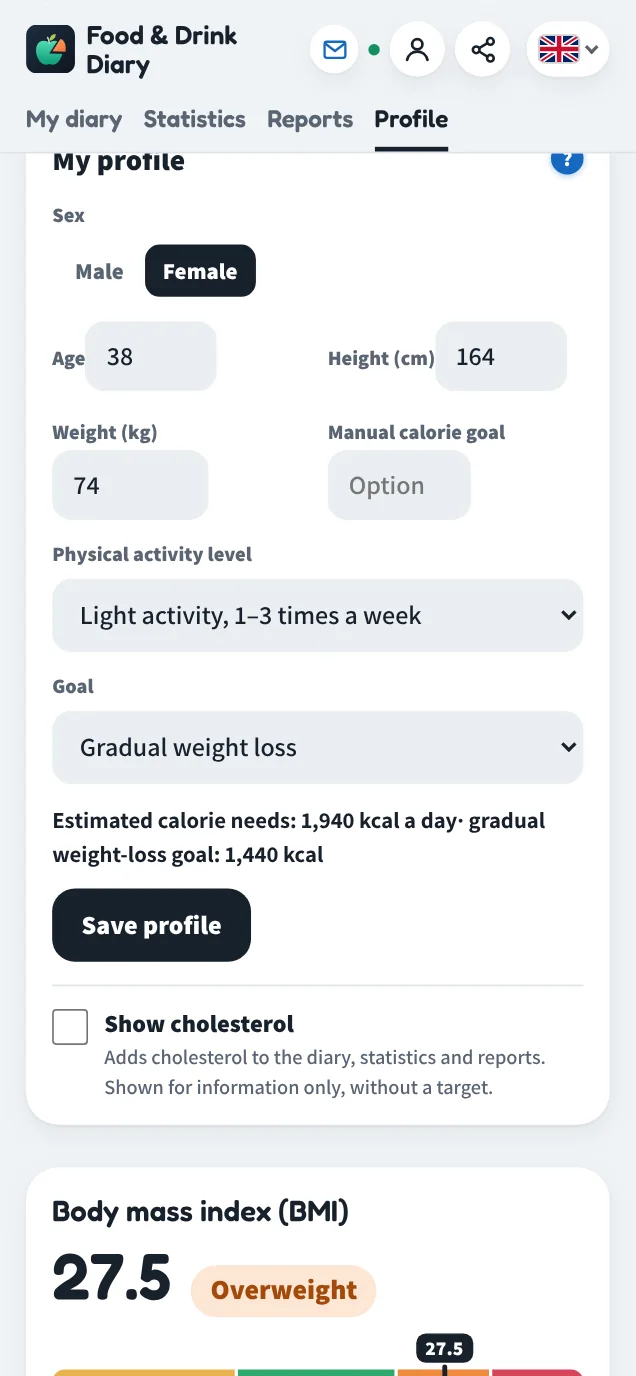
The profile screen: sex, age, height, weight, activity and goal, and the daily target worked out from them
Step 2

Adding a meal

  • In My diary, tap Add meal and choose breakfast, snack, lunch, dinner or night.
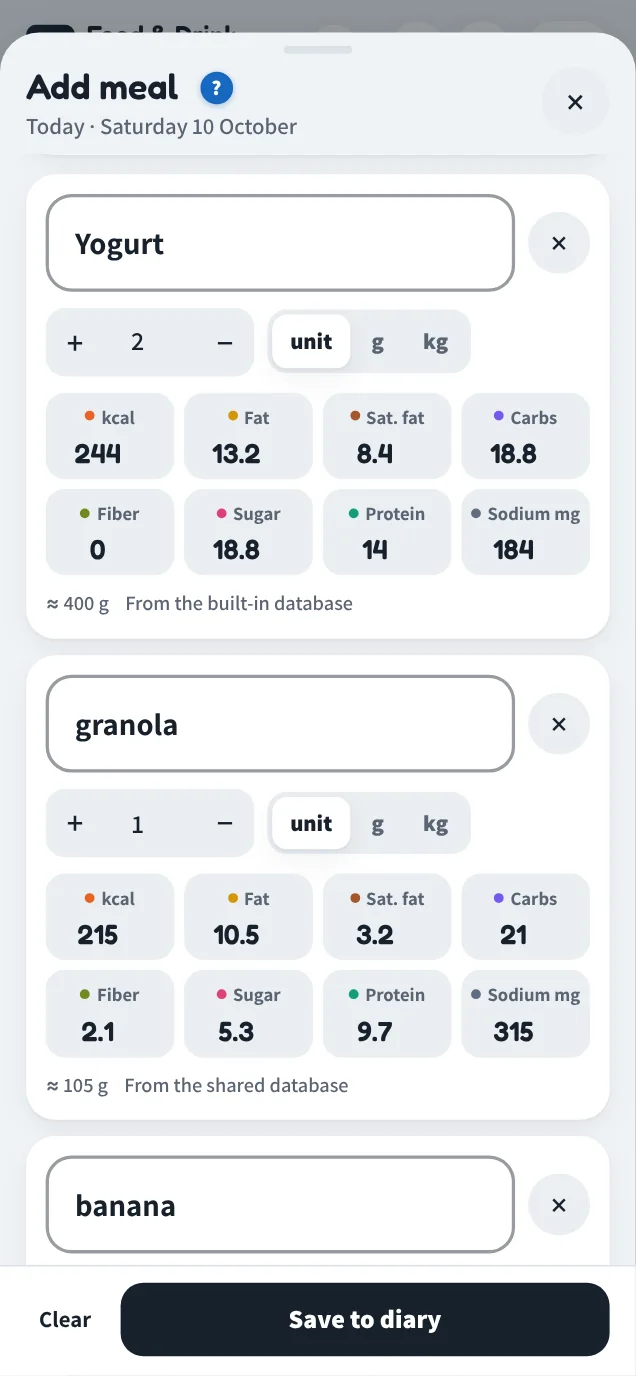
  • Type what you ate in one line, with a comma between foods, for example: yogurt, granola, banana. You can also say the meal aloud, photograph your plate or scan the barcode of a packaged product.
  • Tap Calculate values, and each food gets its own row, with its amount and values.

Changing an amount is easy: delete the number in the amount field and type another, or tap + and − on either side. Next to the amount, choose the unit: units, grams or kg.

Tap Save to diary, and the meal appears in What I ate, with the daily summary.

The add-meal window: each food in its own row, with plus and minus buttons for the amount, a choice of unit, and the nutritional values
Step 3

Photo of the meal, and barcodes

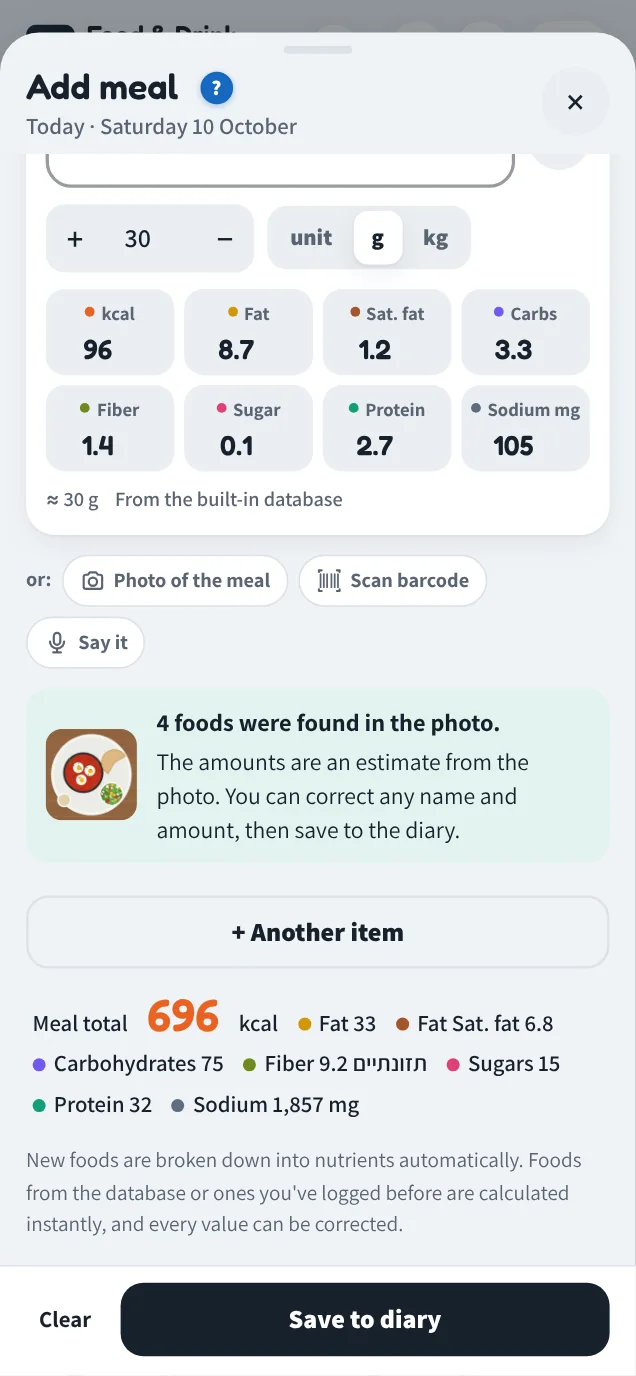
In the Add meal window, tap Photo of the meal and take a picture of your plate from above, or choose a photo from your gallery. The diary identifies the foods in the photo and estimates the weight of each, and every food goes into its own row, with its values.

The amounts are an estimate, and you can correct any name and amount before saving. The photo is sent for identification only and is not kept. During the trial: one photo a day; with a subscription: up to 10 photos a day.

Scan barcode is for packaged products: point the camera at the barcode on the package, and the diary finds the product with the values from its label. A product it doesn't know yet? Type its name once, and the diary will remember it.

The add-meal window after a photo: each food that was found in its own row, with its estimated weight and values
Step 4

The drinks diary

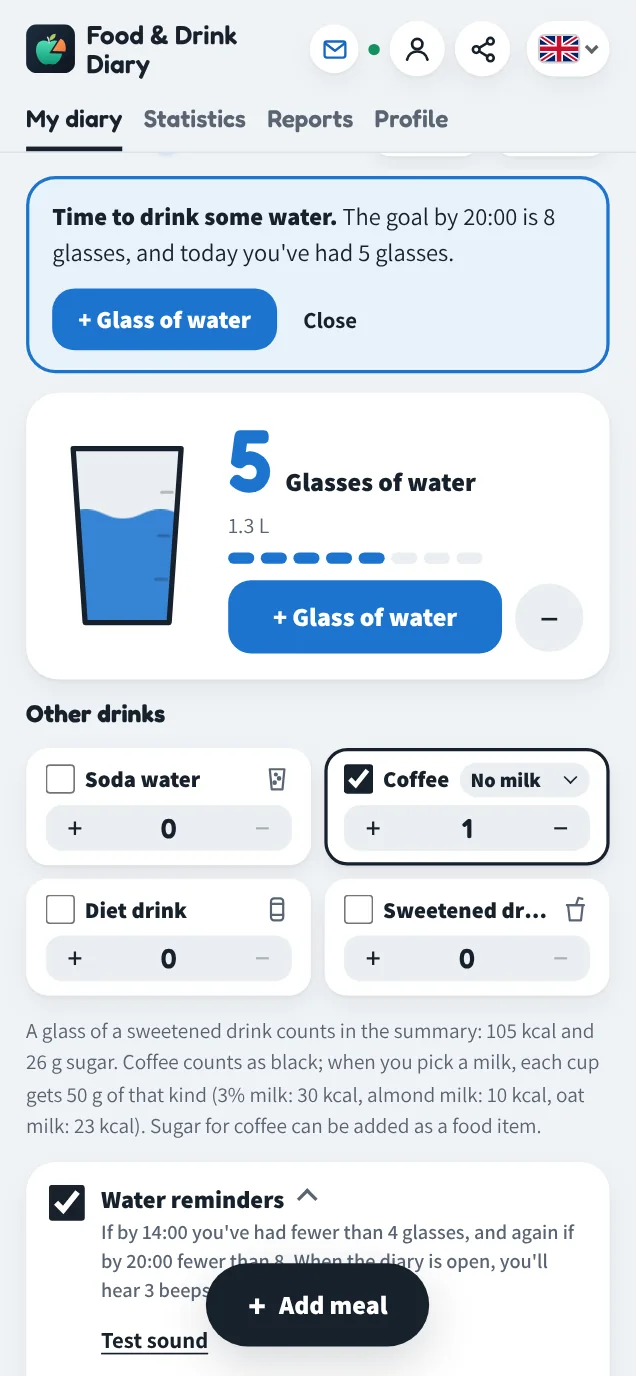
For every glass of water, tap the glass on the main screen, and you see at once how much you have drunk against your daily target: 8 or 10 glasses, as you choose.

Coffee, soda water and sweetened drinks are logged separately, with their sugar and calories; for coffee you also choose the kind of milk.

Reminders to drink: if by 14:00 you have had fewer than 4 glasses, or by 20:00 fewer than 8, a reminder comes to your phone, even when the diary is closed.

The drinks card on the main screen: glasses of water against the target, and coffee and other drinks
Step 5

Statistics

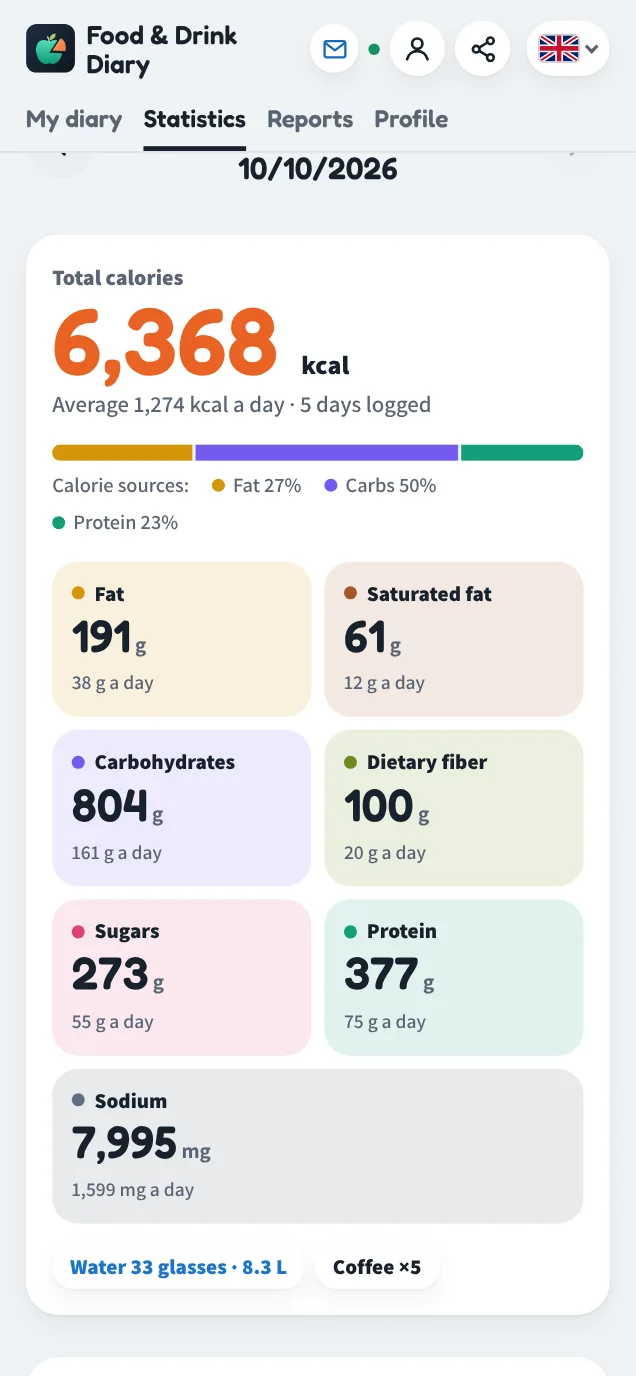
In the Statistics tab, choose a day, week or month, and see the daily average of each value against the recommendation: calories, protein, fat, carbohydrates, sugar, fibre and sodium.

The diary also shows where your calories come from, and a chart of each value over the days. So you see a trend, not just a single day.

The statistics screen: daily averages for a week against the recommendation
Step 6

My reports

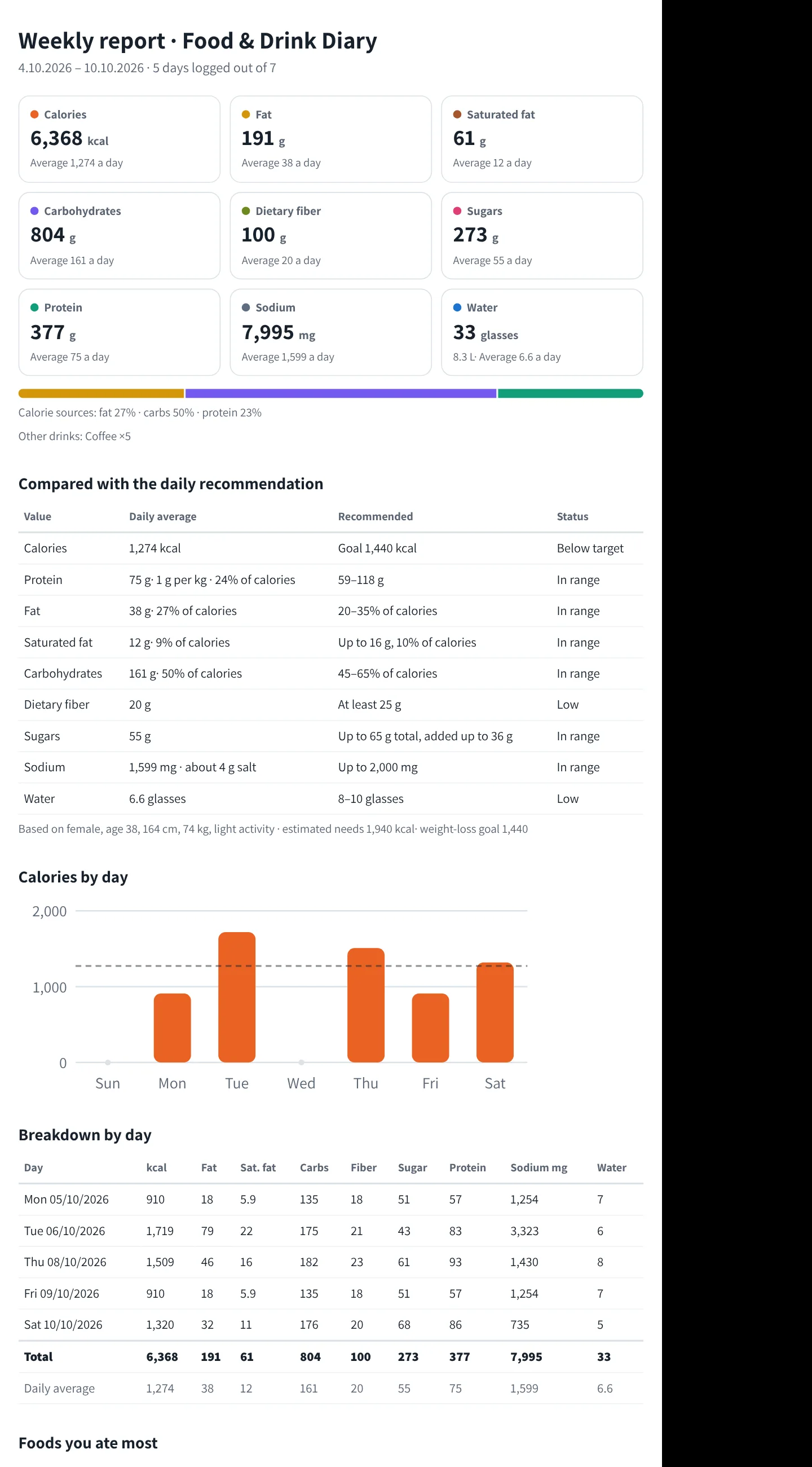
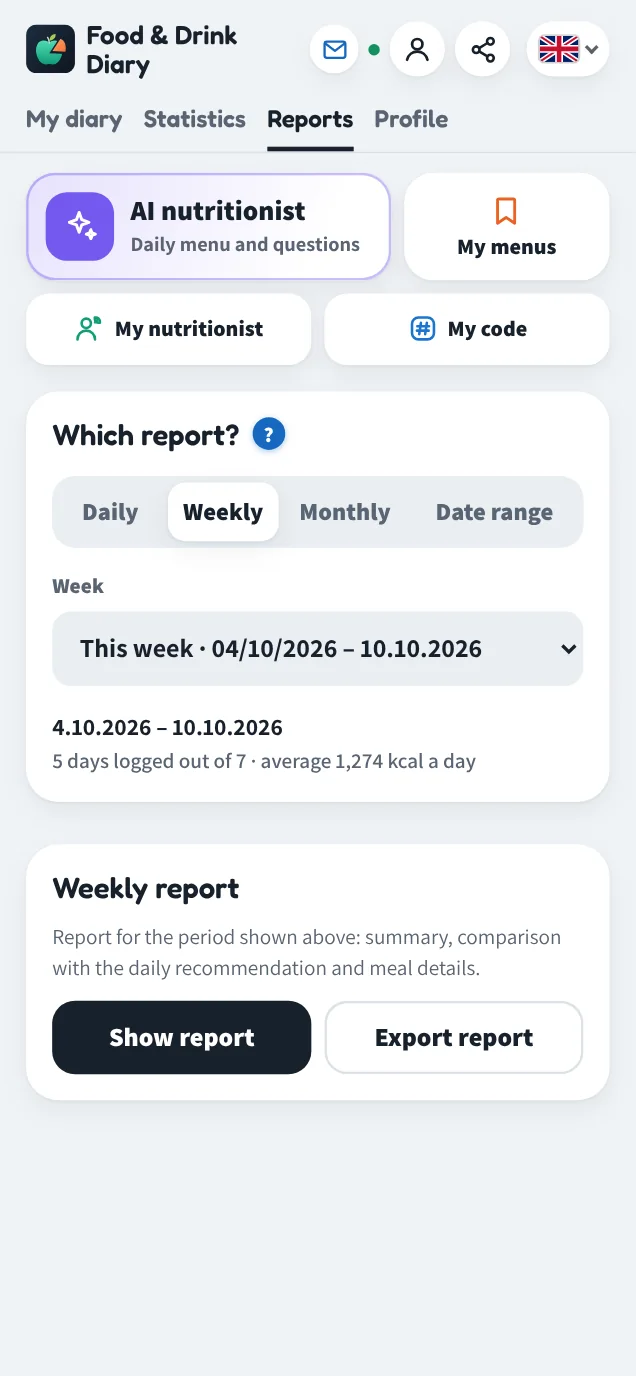
In the Reports tab, choose a daily, weekly or monthly report, or dates of your own, and tap Show report. In the report: a summary, a comparison with the daily recommendation, a chart and a day-by-day breakdown.

With the Export report button you send the report by WhatsApp or email, or save it as a PDF, for example to show a dietitian or your doctor.

A sample weekly report: totals for the week, a comparison with the daily recommendation, a chart of calories by day and a day-by-day breakdown
A sample weekly report, from the app
The reports screen: choosing the kind of report, viewing and sending it
Step 7

AI nutritionist

The AI nutritionist makes a daily menu and answers general questions about nutrition, with a source for every piece of information. For each meal on the menu you can ask for another suggestion.

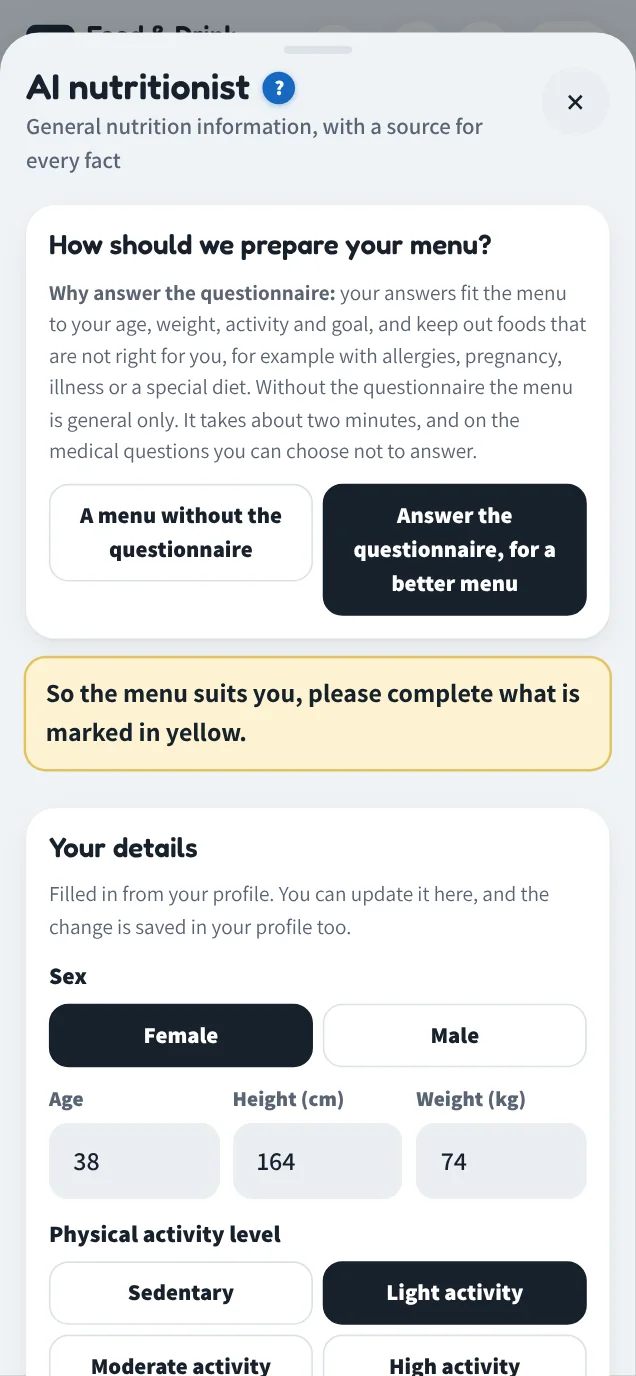
Why fill in the questionnaire: your answers fit the menu to your age, weight, activity and goal, and leave out foods that don't suit you, for example with allergies, in pregnancy, with an illness or on a special diet. Without the questionnaire the menu is general only.

The questionnaire takes about two minutes, and you may choose not to answer the medical questions.

AI nutritionist: choosing between a menu with the questionnaire and a general menu, and why it is worth answering
Step 8

My menus

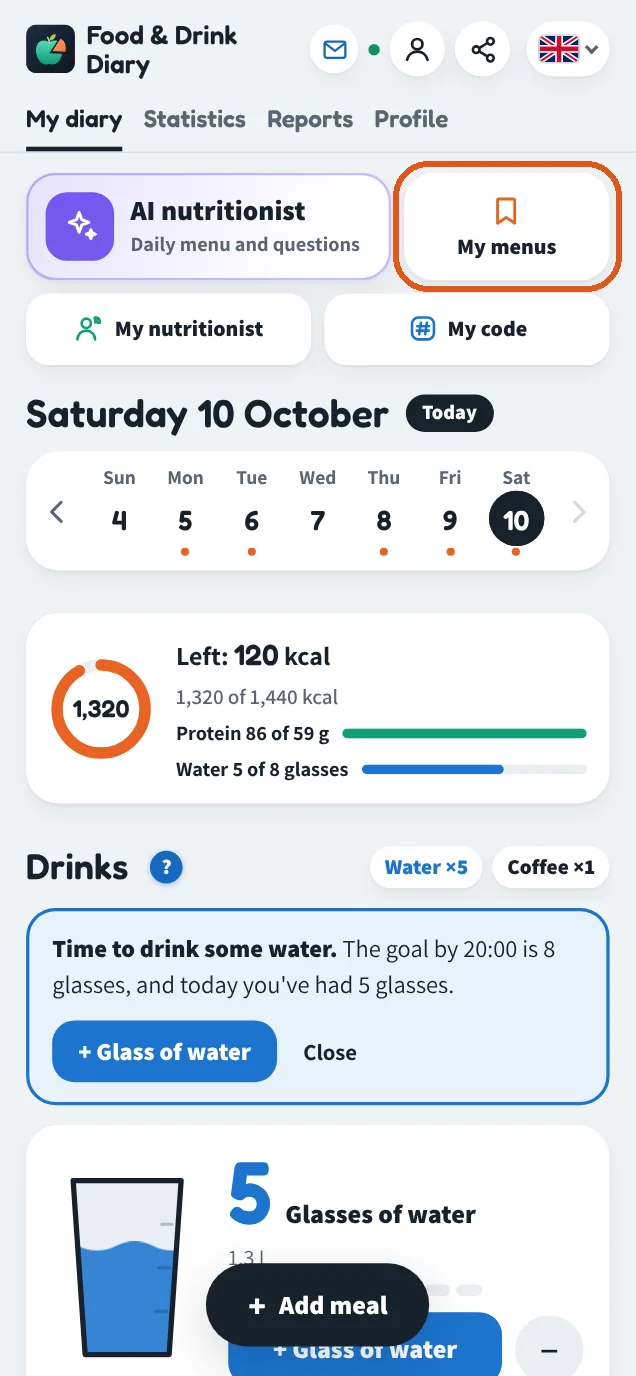
The My menus button is on the main screen, next to the AI nutritionist. The menus you saved wait there, so you can come back to them at any moment.

A menu appears there only if you saved it in the AI nutritionist, with the Save menu button. A saved menu stays for a week.

The main screen with the AI nutritionist and My menus buttons
Download the app

Download and keep it on your home screen

You must keep the diary on your home screen. That way it opens with one tap, full screen, like any app, and water reminders arrive even when it is closed. On an iPhone, reminders only work this way.

iPhone

  1. Open app.noaplate.com in Safari.
  2. Tap the Share button , the square with the arrow, in the bar at the bottom of the screen.
  3. Scroll down and choose Add to Home Screen, leave Open as Web App on, and tap Add.
  4. From now on, open the diary from its icon.
1. The Share button, in the bar at the bottom of Safari
2. Scroll down and choose "Add to Home Screen"

In the newest versions of iOS, if there is no Share button at the bottom: tap ••• beside the address bar, then Share.

Android

  1. Open app.noaplate.com in Chrome.
  2. Tap ⋮ in the top corner.
  3. Choose Install app or Add to Home screen, and confirm.
  4. From now on, open the diary from its icon.

Computer

  1. Open app.noaplate.com in Chrome or Edge.
  2. Click the install icon at the side of the address bar, or Install in the menu, and confirm. The diary opens in its own window.
  3. On Windows: right-click its icon in the taskbar and choose Pin to taskbar.
  4. On a Mac: right-click the icon in the Dock, and choose Options, then Keep in Dock.

Price: right now the app is free, during a trial period. Later you will be able to pay inside the app to extend it.

Good to know

The app includes an explicit statement: the nutritional values are an estimate, and some are worked out with artificial intelligence (AI), which can make mistakes. The owners are not responsible for the quality of the information or for the accuracy of the values.

Everything to do with nutritional advice, allergies and food sensitivities is the user's responsibility. The information in the app is not medical advice and does not replace a doctor or a dietitian. The full details are in the terms of use.

Sources

  1. Lichtman SW, et al. Discrepancy between self-reported and actual caloric intake and exercise in obese subjects. N Engl J Med. 1992;327(27):1893-8. doi:10.1056/NEJM199212313272701
  2. Block JP, et al. Consumers' estimation of calorie content at fast food restaurants: cross sectional observational study. BMJ. 2013;346:f2907. doi:10.1136/bmj.f2907
  3. Hollis JF, et al. Weight loss during the intensive intervention phase of the weight-loss maintenance trial. Am J Prev Med. 2008;35(2):118-26. doi:10.1016/j.amepre.2008.04.013
  4. Harvey J, et al. Log often, lose more: electronic dietary self-monitoring for weight loss. Obesity (Silver Spring). 2019;27(3):380-4. PubMed 30801989
  5. Burke LE, Wang J, Sevick MA. Self-monitoring in weight loss: a systematic review of the literature. J Am Diet Assoc. 2011;111(1):92-102. PubMed 21185970
  6. EFSA Panel on Dietetic Products, Nutrition, and Allergies. Scientific opinion on dietary reference values for water. EFSA Journal. 2010;8(3):1459. doi:10.2903/j.efsa.2010.1459
  7. Chang T, Ravi N, Plegue MA, Sonneville KR, Davis MM. Inadequate hydration, BMI, and obesity among US adults: NHANES 2009-2012. Ann Fam Med. 2016;14(4):320-4. doi:10.1370/afm.1951
  8. Ferreira-Pêgo C, et al. Total fluid intake and its determinants: cross-sectional surveys among adults in 13 countries worldwide. Eur J Nutr. 2015;54(Suppl 2):35-43. doi:10.1007/s00394-015-0943-9
  9. Armstrong LE, et al. Mild dehydration affects mood in healthy young women. J Nutr. 2012;142(2):382-8. doi:10.3945/jn.111.142000
  10. Borghi L, et al. Urinary volume, water and recurrences in idiopathic calcium nephrolithiasis: a 5-year randomized prospective study. J Urol. 1996;155(3):839-43. doi:10.1016/S0022-5347(01)66321-3
  11. Dmitrieva NI, et al. Middle-age high normal serum sodium as a risk factor for accelerated biological aging, chronic diseases, and premature mortality. eBioMedicine. 2023;87:104404. doi:10.1016/j.ebiom.2022.104404
  12. Palma L, et al. Dietary water affects human skin hydration and biomechanics. Clin Cosmet Investig Dermatol. 2015;8:413-21. doi:10.2147/CCID.S86822
  13. Dennis EA, et al. Water consumption increases weight loss during a hypocaloric diet intervention in middle-aged and older adults. Obesity (Silver Spring). 2010;18(2):300-7. doi:10.1038/oby.2009.235
Download